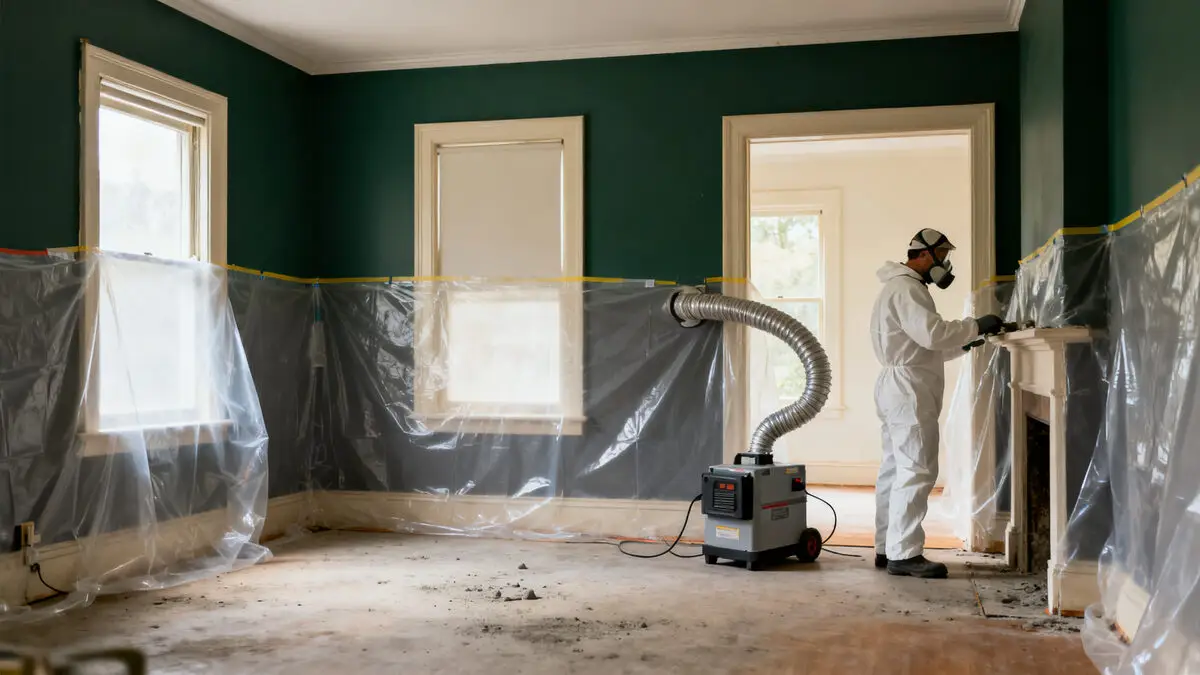
Yes — it is legal to sell a house with asbestos in California, and no state or federal law requires you to remove it before you sell. What the law does require is disclosure: if you know the home contains asbestos, you have to say so on the Transfer Disclosure Statement (TDS). Selling a home with asbestos is routine and lawful; concealing asbestos you know about is what creates the problem.
That single distinction — you don’t have to remove it, you have to disclose it — is what trips up most sellers, so it’s worth walking through exactly how the duty works.
What California actually requires
California Civil Code § 1102 requires sellers of residential property with 1–4 units to give the buyer a written Transfer Disclosure Statement covering material facts that affect the property’s value or desirability. Known environmental hazards fall within that duty, and asbestos is specifically the kind of hazard the TDS is meant to capture. If you know the popcorn ceiling tested positive, or a contractor told you the old pipe wrap is asbestos, that’s a known material fact — and it goes on the form.
Two points surprise almost every seller:
- You disclose what you know — you’re not required to go hunting. The law doesn’t force you to test the house before selling. It forbids you from hiding what you’ve already been told or have good reason to know. There’s no duty to investigate, but there’s a firm duty not to conceal.
- “As-is” does not get you out of it. Under Civil Code § 1102.1, the TDS cannot be waived, even in an as-is sale. “As-is” limits your obligation to repair things; it does nothing to your obligation to disclose them. Sellers routinely assume as-is is a shield here. It isn’t.
Is there a federal asbestos disclosure law?
No — and this catches sellers who’ve heard about the lead-paint rule. Federal law requires sellers to disclose known lead-based paint in homes built before 1978, but there is no equivalent federal mandate for asbestos in a residential sale. For asbestos, the obligation is a matter of California state law and the seller’s duty to disclose known material facts — not a federal form. So the honest summary is: no federal asbestos disclosure requirement, a firm California disclosure duty, and no removal requirement at any level of government.
Beyond the statutory TDS form, California sellers also carry a broader common-law duty to disclose known material facts affecting a property’s value or desirability. Asbestos in a condition a reasonable buyer would want to know about sits inside that duty too — which is why “it wasn’t on the form” is not a defense for concealing something you knew.
Why sellers test even though they don’t have to
Since disclosure only covers what you know, some sellers reason that not testing keeps them in the clear. In practice it usually does the opposite. An older Salinas home almost certainly contains some suspect material — popcorn ceilings, vinyl floor tile, pipe insulation, exterior siding — and a buyer’s inspector may well flag it. When that happens mid-escrow with no answer on file, the deal stalls while everyone scrambles.
A test before listing turns “I’m not sure” into a documented fact. That’s why many sellers and their agents order asbestos testing and inspection up front:
- The disclosure is accurate, not a guess, so it can’t be challenged later as concealment.
- There are no surprises during the buyer’s inspection that reopen negotiations.
- If a buyer asks “what would it cost to deal with this?”, you can point to an honest local cost range instead of letting fear set the price.
Testing is inexpensive relative to a blown escrow, and it shifts the conversation from anxiety to facts — which is exactly where a seller wants it.
What you don’t have to do
It’s just as important to know the limits, because bad advice in the other direction costs sellers money:
- You don’t have to remove asbestos to sell. Material in good, undisturbed condition is frequently left safely in place. Ripping out a sound popcorn ceiling purely to sell is often an unnecessary expense.
- You don’t have to remove it for the buyer to get a loan or insurance, as a general matter. Most standard residential transactions close with asbestos-containing materials in place. If a particular lender or buyer raises it, a documented survey of the material’s condition usually settles the question.
- You don’t have to scare the buyer. Honest disclosure is a factual line item, not a warning label. The calm version — “the home contains an asbestos popcorn ceiling in good condition, per the attached lab report” — is both fully compliant and far easier to sell than silence followed by a nasty inspection surprise.
For agents listing these homes
If you’re a real-estate agent listing an older Salinas or Monterey County property, the cleanest transactions are the ones where the asbestos question is answered before it becomes a negotiating point. A pre-listing test, or a pre-demolition or pre-renovation survey when the buyer plans to remodel, gives you documentation to attach to the disclosure package and keeps the deal moving. We work directly with agents to schedule testing on listing timelines — tell us the close date and we’ll work to it.
The bottom line
Selling a California home with asbestos is legal and common. The whole obligation reduces to one honest sentence on the TDS: disclose what you know. Where you’re unsure, a test removes the uncertainty — protecting the seller, keeping escrow on track, and letting the sale close on facts instead of fear. If you’re preparing to list in the Salinas area, the simplest first step is to find out exactly what’s there.